What Size Dumpster Do You Need for a Home Cleanout?
A home cleanout can start with a single closet and quickly turn into a full garage, basement, attic, or whole-house project. Old furniture, broken appliances, boxes of stored belongings, carpet, yard debris, and general household junk often take up more space than expected once everything is pulled out and sorted. Choosing the right dumpster size helps keep the project organized and can reduce the chance of needing a second container.
For homeowners, landlords, estate representatives, and property managers in Kalamazoo, MI, dumpster sizing usually depends on three main factors: the amount of material, the type of debris, and how much room is available for placement. A small decluttering project may only need a compact roll-off container, while a full home cleanout after a move, renovation, or estate transition may require a larger size. This guide explains how common dumpster sizes are used and what to consider before scheduling a container for residential cleanup.
Why Dumpster Size Matters During a Home Cleanout
Dumpster size affects more than price. It can influence how fast the cleanup moves, how safely debris is handled, and whether the container fits in the available space. A dumpster that is too small may fill before the project is done, leaving piles of debris waiting for another pickup. A dumpster that is too large may be unnecessary for a simple room cleanout and may take up more driveway space than needed.
Most roll-off dumpsters are measured in cubic yards. One cubic yard is roughly the volume of a household washing machine. A 10-yard dumpster holds about 10 cubic yards of debris, while a 20-yard dumpster holds about twice that amount. The exact amount that fits depends on the shape and weight of the items. Bulky furniture can fill a container quickly even if it does not weigh much. Heavy materials such as plaster, tile, dirt, brick, or concrete may reach the weight limit before the dumpster looks full.
During a home cleanout, volume is usually the main concern. Items are often irregular in shape and difficult to stack neatly. Sofas, mattresses, shelving, cardboard boxes, broken tables, bags of clothing, and household clutter leave air gaps inside the container. That is why a project that looks moderate at first can require more space once everything is loaded.
Common Dumpster Sizes for Residential Cleanouts
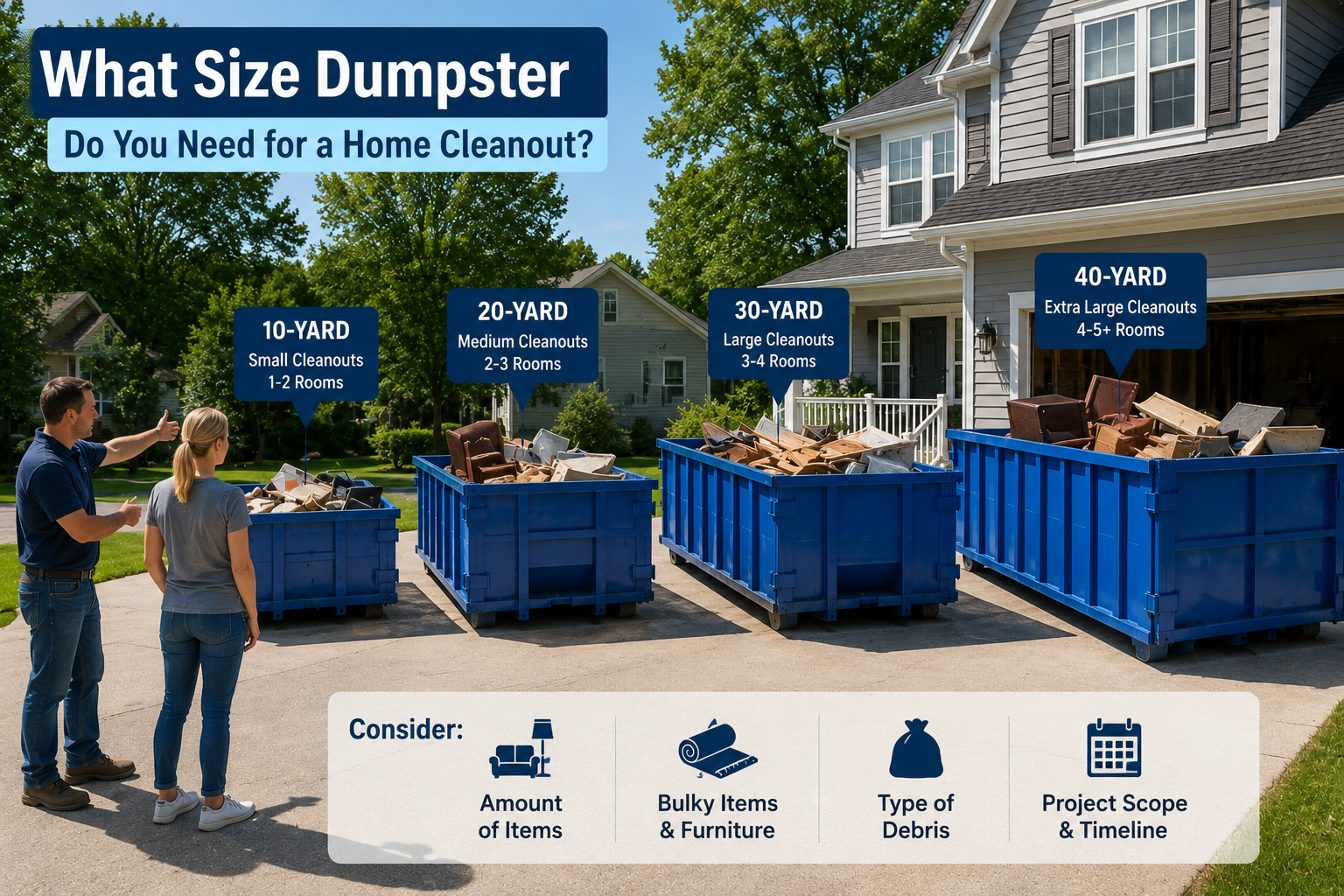
Dumpster sizes vary by provider, but residential cleanout projects commonly use 10-yard, 15-yard, 20-yard, and 30-yard roll-off containers. Each size fits a different type of project. Choosing the right one starts with estimating the scale of the cleanup, then allowing a little extra room for unexpected items.
A 10-yard dumpster is often used for small cleanouts. It may work well for clearing a spare bedroom, removing boxes from an attic, cleaning a small garage, or disposing of light household junk from a rental turnover. This size is also useful when driveway space is limited. Because it is smaller, it can be easier to place in tighter residential areas, though placement still depends on access and local rules.
A 15-yard dumpster gives more room without taking up as much space as larger containers. It may be suitable for a larger garage cleanout, a small basement project, or a partial home cleanout before listing a property for sale. This size can handle a mix of furniture, bagged debris, cardboard, and general junk when the project is more than a light decluttering effort but not quite a full-house cleanout.
A 20-yard dumpster is one of the most common choices for home cleanouts. It can handle larger furniture, multiple rooms of debris, old carpeting, broken household items, and accumulated clutter from storage areas. Many homeowners choose this size when they are cleaning out a basement, preparing for a move, or dealing with years of stored belongings. For many projects involving dumpster rental in Kalamazoo, a 20-yard container may offer a practical balance between capacity and driveway fit.
A 30-yard dumpster is usually reserved for larger cleanouts. This size may be appropriate for estate cleanouts, foreclosure cleanups, major downsizing projects, or whole-house junk removal. It offers more room for bulky items and large amounts of mixed household debris. However, it also requires more placement space and may not be ideal for every residential driveway.
- 10-yard dumpster: Small room, attic, or light garage cleanout
- 15-yard dumpster: Medium garage, basement, or partial home cleanout
- 20-yard dumpster: Multi-room cleanout, moving cleanup, or large household junk project
- 30-yard dumpster: Estate cleanout, full-house cleanout, or major property cleanup
Project Examples That Help With Sizing
Realistic cleanup scenarios can make dumpster sizing easier. A homeowner clearing a single-car garage may find that a 10-yard or 15-yard dumpster is enough if the debris includes old boxes, broken tools, small shelving units, and bagged trash. If the garage also contains furniture, tires, appliances, or construction leftovers, a larger container may be more practical.
A basement cleanout can be harder to estimate because items tend to accumulate over many years. Boxes of decorations, old exercise equipment, damaged furniture, carpet remnants, and stored household goods can fill a container quickly. For a lightly used basement, a 15-yard dumpster may be enough. For a packed basement with bulky items, a 20-yard dumpster is often the safer estimate.
Estate cleanouts usually require more capacity than expected. Even when the home appears organized, every room may contain furniture, clothing, papers, books, kitchen items, linens, and stored personal belongings. The cleanup may also include garage contents, outdoor furniture, and basement storage. A 20-yard dumpster may work for a smaller estate cleanout, while a 30-yard dumpster may be better for a larger property or a home with decades of belongings.
Rental property cleanouts are another common scenario. A landlord may need to remove left-behind furniture, mattresses, broken household items, and general trash before repairs or new tenants. A small apartment may only need a 10-yard or 15-yard container. A single-family rental with garage or basement debris may require a 20-yard dumpster.
Renovation-related cleanouts are different from general junk removal because the debris may be heavier. Cabinets, drywall, flooring, trim, and fixtures can add weight quickly. When cleanup includes remodeling debris, it helps to review material types carefully. The EPA guidance on managing debris after a natural disaster notes that debris may need to be separated into categories such as household garbage, construction debris, vegetative debris, appliances, and household hazardous waste. While that guidance is written for disaster cleanup, the basic idea of separating materials is useful for many residential projects.
Debris Type Can Affect the Right Dumpster Size
Not all debris loads the same way. A dumpster filled with cardboard boxes may hold a large amount of material without becoming too heavy. A dumpster filled with tile, plaster, concrete, or soil may become overweight before reaching the top. For a home cleanout, the debris mix is usually lighter than construction demolition debris, but certain items still need attention.
Bulky items are the most common reason homeowners underestimate size. Mattresses, couches, recliners, dressers, cabinets, and entertainment centers take up significant space. Breaking down items when possible can help create more room, but not everything can be flattened or stacked. Long boards, bed frames, and shelving can also make loading less efficient.
Some materials may be restricted or require special handling. Paint, solvents, pesticides, motor oil, batteries, propane tanks, and certain electronics should not be tossed into a general debris container without checking disposal rules. Kalamazoo-area residents should review local waste and recycling options for household hazardous waste before the cleanout begins. Separating these items early helps avoid delays and keeps the dumpster load focused on accepted materials.
Yard debris may also need separate planning. Branches, leaves, brush, and logs can take up a lot of volume. If a home cleanout includes shed removal, storm debris, or landscape cleanup, it is worth confirming whether vegetative debris can be mixed with household junk. Some disposal facilities prefer or require separation.
Space, Access, and Placement Considerations
Dumpster size is not only about debris volume. The container also has to fit safely on the property. Driveways are the most common placement area for residential projects because they provide stable access and keep the container close to the work area. However, narrow driveways, low tree branches, parked vehicles, steep slopes, and overhead wires can affect placement.
Before choosing a dumpster, it helps to look at the route from the street to the placement area. The delivery truck needs enough room to approach, unload, and later retrieve the container. A larger dumpster may require more clearance than a smaller one. In some neighborhoods, street placement may require permission from the city or another local authority. This is especially important in denser parts of Kalamazoo, MI, where driveways may be shorter or on-street parking may be limited.
Loading height also matters. Smaller dumpsters often have lower walls, which can make them easier to load by hand. Larger dumpsters provide more capacity but may be taller. Many roll-off containers have a swinging door, allowing people to walk in heavy items instead of lifting everything over the side. For cleanouts involving furniture, boxes, and bulky household goods, door access can make the project more manageable.
Scheduling should also be considered. Some cleanouts happen in a single weekend, while others take several days as family members sort, donate, recycle, and dispose of items. A container that is onsite long enough for careful sorting can reduce rushed decisions. For broader cleanup planning, a separate construction cleanup guide may be helpful when the project includes remodeling debris or contractor-related waste.
How to Avoid Choosing a Dumpster That Is Too Small
The most common sizing mistake is choosing a container based only on what is visible at the beginning of the project. Closets, crawlspaces, sheds, attics, and cabinets often contain more material than expected. Once items are pulled out, sorted, and bagged, the pile may grow quickly. A slightly larger dumpster can sometimes be more practical than trying to make a smaller one work.
A useful approach is to walk through the property and group items by area. Estimate the debris from each room, then include storage spaces and outdoor areas. Large furniture should be counted separately because it takes up more room than bagged trash. If the cleanout includes carpet, padding, shelving, or minor renovation debris, that should be factored in as well.
Weight limits should also be reviewed. Even household junk can become heavy when the load includes books, files, tools, small appliances, flooring, or wet materials. Filling the dumpster evenly helps prevent shifting during pickup. Heavy items should generally be placed low and spread out instead of stacked in one corner.
It is also important not to overfill the container. Roll-off dumpsters usually need to be loaded level with the top edge so they can be safely covered and transported. Items sticking above the rim may create a safety issue and could require removal before pickup. Planning for a little extra space helps avoid this problem.
For residents comparing options for roll-off dumpster rental in Kalamazoo, project size, debris type, driveway access, and cleanup timeline should all be considered together. Kalamazoo Dumpster Colex is one local brand associated with roll-off dumpster information for the area, but the same general sizing principles apply to most residential cleanout projects.
Choosing the Best Size for a Typical Home Cleanout
For a small decluttering project, a 10-yard dumpster may be enough. This is usually a practical choice when the cleanup is limited to one area of the home and does not include large furniture. For a more involved project, such as a garage and basement cleanout, a 15-yard or 20-yard dumpster is often more realistic.
For many whole-home cleanouts, a 20-yard dumpster is a common starting point. It provides enough room for a mix of furniture, boxes, bagged junk, and general household debris without being as large as a 30-yard container. However, a larger home, an estate cleanout, or a property with several storage areas may justify a 30-yard dumpster.
The best size is usually the one that fits the property, handles the debris safely, and leaves enough room for unexpected items. A careful walk-through before the rental is scheduled can prevent many sizing problems. Taking photos of the debris piles or listing large items can also help when comparing container sizes.
Conclusion
Choosing the right dumpster for a home cleanout comes down to volume, weight, debris type, and available space. Small cleanouts may only need a 10-yard container, while larger basement, garage, estate, or whole-house projects often require 20 yards or more. In Kalamazoo, MI, homeowners and property managers can make better sizing decisions by reviewing each cleanup area, separating restricted materials, and allowing room for bulky items. A realistic estimate at the start can make the entire cleanout safer, cleaner, and easier to manage.